|

The OTAVA GPCR Agonist Library is a computationally refined collection built to explore GPCR-privileged chemical space with high scaffold diversity and strong agonist-like physicochemical profiles.
GPCRs represent the largest class of druggable membrane receptors in human biology and remain a dominant source of first-in-class small-molecule therapeutics across CNS, metabolic, cardiovascular, inflammatory, and endocrine indications.
Because GPCR agonists rely on subtle shape complementarity, balanced lipophilicity, and privileged heteroaromatic frameworks, a well-diversified scaffold architecture is essential for efficient hit discovery.
Our library provides a high-value starting point by combining expertly curated structures with modern AI-guided enrichment strategies, enabling broad SAR exploration and effective initiation of GPCR agonist discovery programs.
GPCR Target Class Significance
GPCRs regulate key physiological processes including neurotransmission, hormone signaling, immune modulation, and sensory perception.
Dysregulation of GPCR pathways contributes to a wide range of disorders such as:
-
Neurological and psychiatric diseases (e.g., Parkinson’s, depression, anxiety)
-
Metabolic disorders (type 2 diabetes, obesity)
-
Cardiovascular dysfunction
-
Inflammatory and autoimmune conditions
-
Respiratory diseases
-
Pain and nociception
Because GPCR agonists can selectively activate signaling pathways with fine-tuned pharmacology (biased signaling, subtype bias, tissue selectivity), discovering structurally diverse small molecules remains a high strategic priority in drug development.
Library Design and Computational Workflow
1. High-value GPCR CORE set
The starting collection consists of 1,067 manually curated GPCR-relevant compounds, filtered for structural integrity, drug-like properties, and absence of major liabilities (PAINS, REOS, reactive motifs).
Murcko scaffold extraction identified 595 unique core frameworks, representing an unusually strong scaffold-to-compound diversity ratio and enabling broad exploration of GPCR-privileged chemotypes.
2. AI-Driven Expansion and Bayesian Enrichment
The AI-optimized core of 595 representative compounds can be readily expanded to approximately 1,067 structures by including all pre-clustered analogs prior to Murcko filtering, and further extended to about 2,700 predicted candidates generated through Bayesian modeling - guided enrichment of GPCR-privileged chemotypes.
3. Structural Standardization and Feature Engineering
All structures were standardized through canonical SMILES generation, salt removal, tautomer normalization, and InChIKey-based deduplication.
For each molecule, we computed:
-
ECFP4/Morgan fingerprints
-
Murcko scaffolds
-
Physicochemical descriptors (MolWt, cLogP, TPSA, HBA/HBD, RotB, QED)
-
Privileged motif identifiers
-
PAINS/reactivity flags
This ensured consistent machine-learning-ready data representation.
4. Machine-Learning Scoring
ML were applied over a proprietary ~300,000-compound stock.
Compounds were evaluated across:
-
GPCR-privileged fragments
-
Structural proximity to agonist-like chemotypes
-
Favorable physicochemical ranges characteristic of orally available GPCR agonists
Final candidates represent the top-scoring, scaffold-diverse portion of the enriched chemical space.
Scaffold Diversity and Chemospace Coverage
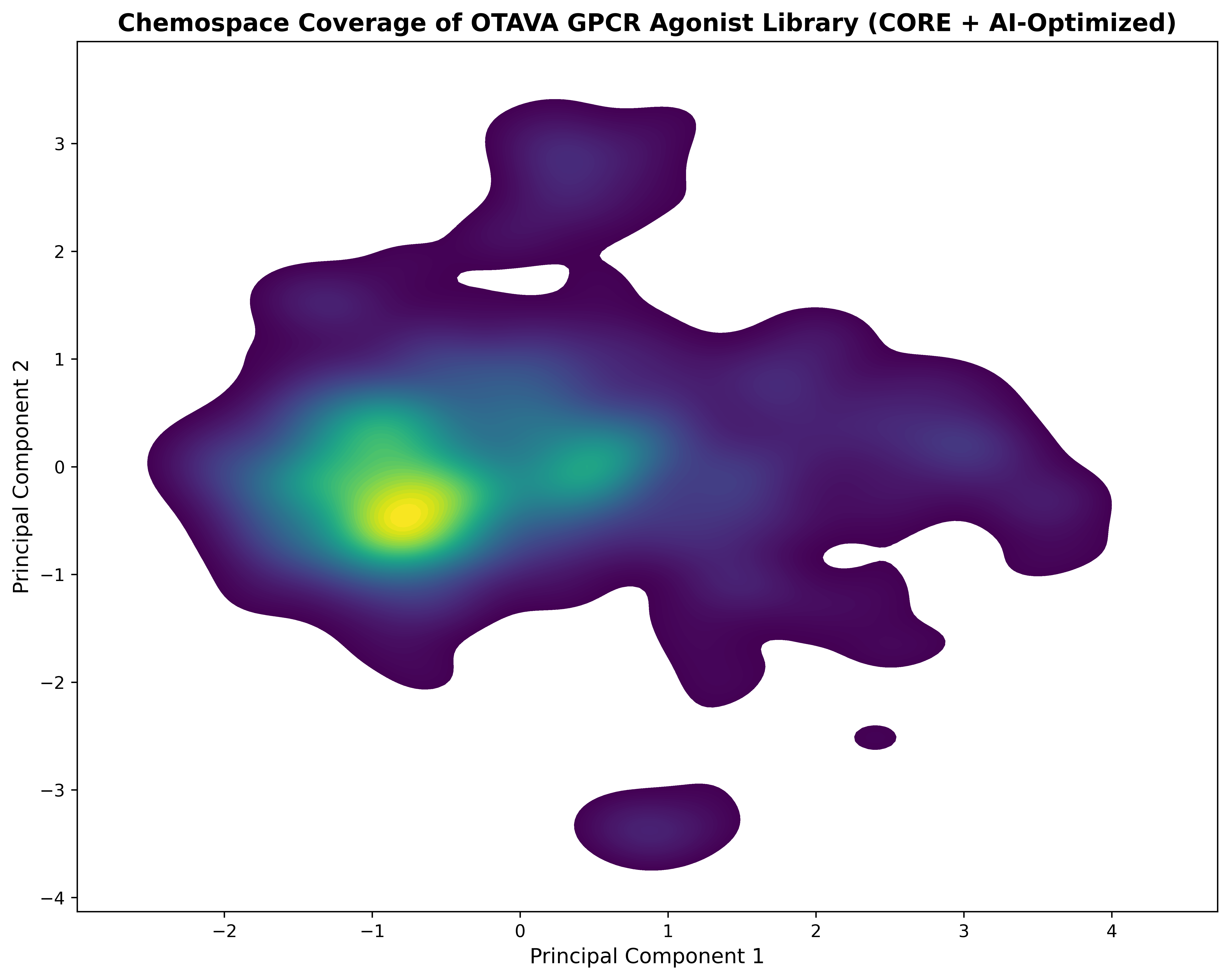
PCA of the curated + AI-expanded set demonstrates:
-
A dense central GPCR-drug-like region, comprising heteroaromatic scaffolds, bicyclic frameworks, and fused motifs
-
Multiple peripheral clusters capturing alternative shape profiles, rigid/semi-rigid frameworks, and unique aromatic architectures
-
Smooth, continuous coverage of GPCR-relevant chemical space, indicating balanced diversity without sparsity gaps
This ensures complementary SAR exploration potential across GPCR families.

All the compounds are in stock, cherry-picking is available.
The libraries (DB, SD, XLS, PDF format) as well as the price-list are available on request. Feel free to contact us or use on-line form below to send an inquiry if you are interested to obtain this library or if you need more information.
Request Your Library Today! Fill out the form:
|

 HOME
HOME Overview