|
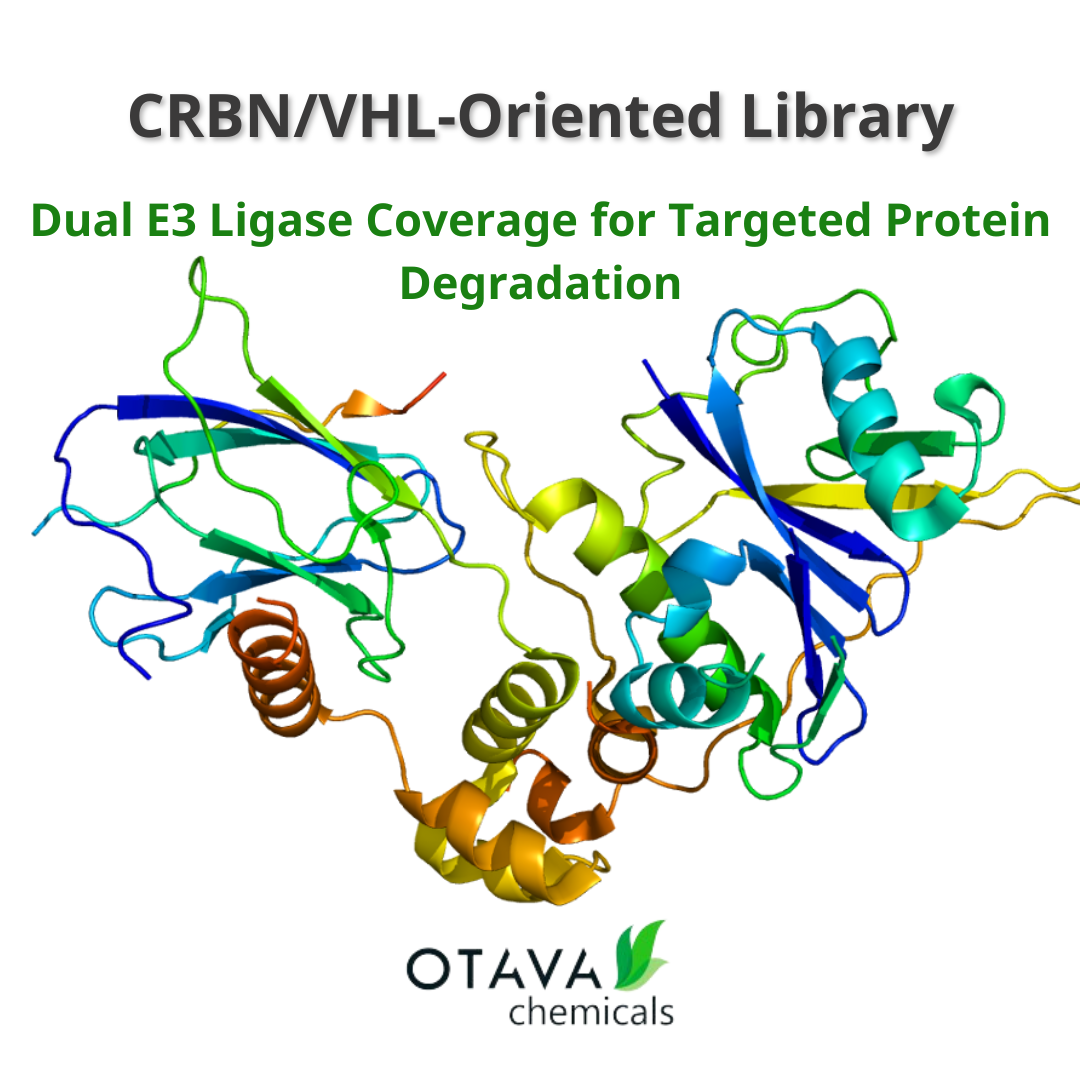
Targeted protein degradation (TPD) has emerged as a transformative drug discovery modality, enabling the selective elimination of disease-relevant proteins through hijacking of the cell's own ubiquitin–proteasome system. At the core of modern TPD strategies are E3 ubiquitin ligases - most prominently cereblon (CRBN) and von Hippel–Lindau protein (VHL) - which serve as recruiter platforms in both bifunctional PROTACs and molecular glue degraders.
The OTAVA Mixed CRBN/VHL-Oriented Library was assembled to provide dual coverage of these two complementary E3 ligase systems within a single, experimentally actionable screening panel. With 2,400 compounds, this library is designed to support comparative E3 ligase screening, recruiter warhead discovery, and early-stage degrader program initiation.
The library integrates two distinct selection logics: a CRBN- and molecular-glue-oriented component enriched for CELMoD-compatible and IMiD-like chemotypes, and a complementary VHL-oriented component selected through ligand-based similarity to experimentally validated VHL binders. This dual-track design reflects the limited structural overlap between canonical CRBN and VHL recruiter chemotypes and ensures that both ligase systems are genuinely represented at the chemical level.
Scientific Rationale: Why Both CRBN and VHL?
CRBN and VHL are the two most mature and widely exploited E3 ligase recruitment systems in TPD, yet they occupy distinct ligand-recognition space and support different degradation strategies. CRBN - the substrate receptor of the CRL4CRBN complex - is central to IMiD biology, CELMoD pharmacology, and molecular glue degrader discovery. Its ligand-binding pocket, formed around a conserved tryptophan triad, accommodates compact glutarimide-based scaffolds and supports both bifunctional PROTAC recruitment and induced neosubstrate recognition. Recent work has expanded the predicted CRBN-compatible target universe to more than 1,600 G-loop proteins, underscoring the breadth of this ligase system.
VHL - the substrate receptor of the CRL2VHL complex - offers a well-defined, structure-guided recruiter scaffold derived from the hydroxyproline-containing HIF-α recognition motif. VHL ligands benefit from strong structural rationale, well-characterized SAR, and comparatively clean recruiter pharmacology with limited neosubstrate liabilities. Recent advances include the development of covalent VHL recruiters and continued expansion of VHL ligand structural diversity beyond the classical hydroxyproline paradigm.
A panel that samples both CRBN- and VHL-oriented chemotypes provides information that a single-ligase collection cannot: it reveals whether observed activity is ligase-specific, scaffold-dependent, or distributed across both recruitment contexts - a distinction that is critical for early program decision-making.
Library Design Workflow
Track 1 - CRBN and Molecular Glue Component
The CRBN-oriented starting set was curated around compounds relevant to cereblon modulation and molecular glue biology. Compounds were selected for structural compatibility with the thalidomide-binding domain (TBD) of CRBN, covering glutarimide-based IMiD-like scaffolds, CELMoD-inspired chemotypes, and diverse molecular glue candidates. This component builds on well-established CRBN ligand chemistry while expanding chemical diversity beyond classical IMiD structures.
Track 2 - VHL-Oriented Component
Because canonical CRBN and VHL recruiter chemotypes overlap only minimally, the VHL component was generated through a separate ligand-similarity workflow applied to the broader OTAVA stock library. The VHL reference panel was built from ChEMBL target CHEMBL3108660 (von Hippel–Lindau disease tumor suppressor), retaining only records with quantitative binding measurements (IC50, Kd, or Ki) after data cleaning and deduplication. The resulting reference set comprised 411 unique, experimentally validated VHL ligands.
All reference ligands and all compounds in the internal stock library were encoded as Morgan fingerprints (ECFP4). Pairwise structural comparison was performed using the Tanimoto coefficient. For each stock compound, two similarity statistics were calculated: (i) the maximum Tanimoto similarity to any known VHL ligand, and (ii) the average similarity across the full VHL reference panel. This dual-scoring scheme simultaneously enriches for close VHL analogs and for molecules that occupy a broader VHL-relevant region of chemical space.
|
Design Element |
Approach |
Rationale |
|
CRBN component |
Glutarimide / CELMoD / molecular glue-compatible chemotypes |
Covers compact recruiter motifs, IMiD-like and next-generation CRBN binder space |
|
VHL reference set |
411 ligands from ChEMBL (CHEMBL3108660), quantitative data only |
Anchors VHL selection to experimentally validated, target-specific binding data |
|
Fingerprint method |
Morgan / ECFP4 fingerprints |
Industry-standard for rapid large-scale scaffold-level similarity comparison |
|
Similarity metric |
Tanimoto coefficient (max + average to reference set) |
Dual scoring enriches for both close analogs and broadly VHL-like chemotypes |
|
Stock coverage |
Full OTAVA stock library (~300,000 compounds) |
Avoids CRBN-chemotype bias; maximizes recovery of distinct VHL-relevant scaffolds |
Library Composition and Structure
The final OTAVA Mixed CRBN/VHL-Oriented Library contains 2,400 compounds spanning both E3 ligase chemotype spaces. The library integrates:
-
CRBN/molecular glue-oriented compounds - selected for compatibility with the CRBN thalidomide-binding domain, suitable as direct screening candidates, molecular glue leads, or recruiter warheads for PROTAC design
-
VHL-oriented compounds - selected by ligand-based similarity to 411 experimentally validated VHL binders, representing hydroxyproline-related and structurally diverse VHL-relevant chemotypes
-
Low overlap between components - the two tracks enrich genuinely distinct chemical spaces, confirming that the dual-track design broadens rather than duplicates recruiter landscape coverage
Important interpretive note: The VHL-oriented compounds were selected by ligand-based similarity enrichment - a standard and well-validated virtual screening approach. These compounds are best regarded as a VHL-enriched hypothesis set for experimental testing rather than prevalidated VHL binders. Orthogonal experimental confirmation (biochemical, biophysical, or cell-based) is recommended for hit validation.
Applications and Capabilities
The Mixed CRBN/VHL-Oriented Library is designed to support multiple stages of early-stage TPD drug discovery:
-
Comparative E3 ligase screening - identify whether target degradation is driven by CRBN or VHL recruitment, or both, within a single panel
-
Recruiter warhead discovery - identify novel CRBN or VHL binders suitable as starting points for bifunctional PROTAC design
-
Molecular glue lead identification - screen for compounds capable of inducing or stabilizing neosubstrate interactions with CRBN
-
CELMoD and next-generation IMiD analogs - explore CRBN modulator chemical space beyond classical thalidomide-class scaffolds
-
VHL ligand expansion - access structurally diverse VHL-relevant chemotypes beyond canonical hydroxyproline-based frameworks
-
Ternary complex and degrader optimization - use library hits as recruiter inputs for linker optimization and degrader profiling studies
Therapeutic Context
The library is particularly valuable for programs in oncology (hematological malignancies, solid tumors), immunology, and any indication where selective protein elimination is preferred over inhibition. CRBN-based degraders have achieved advanced clinical development in multiple myeloma and other hematological cancers, leveraging the high CRBN expression in hematopoietic tissues. VHL-based PROTACs are actively explored for a broader range of solid tumor targets, benefiting from wider tissue expression and well-characterized recruiter pharmacology.
By covering both E3 ligase systems in a single panel, the OTAVA Mixed CRBN/VHL-Oriented Library allows researchers to make data-driven ligase selection decisions at the earliest stages of a program - accelerating the path from target identification to optimized degrader candidates.
Library Summary
|
Parameter |
Value |
|
Total compounds |
2,400 |
|
E3 ligase systems covered |
CRBN (CRL4CRBN) and VHL (CRL2VHL) |
|
CRBN component |
IMiD / CELMoD / molecular glue-compatible chemotypes |
|
VHL component |
Ligand-similarity selected vs. 411 ChEMBL-validated VHL binders (ECFP4 / Tanimoto) |
|
Fingerprint method |
Morgan fingerprints (ECFP4) |
|
Similarity metric |
Tanimoto coefficient (max + mean to VHL reference set) |
|
Primary applications |
E3 ligase comparative screening, PROTAC warhead discovery, molecular glue identification |
|
Therapeutic areas |
Oncology, immunology, targeted protein degradation |
All the compounds are in stock, cherry-picking is available.
The libraries (DB, SD, XLS, PDF format) as well as the price-list are available on request. Feel free to contact us or use on-line form below to send an inquiry if you are interested to obtain this library or if you need more information.
Request Your Library Today! Fill out the form:
|

 HOME
HOME Overview