|

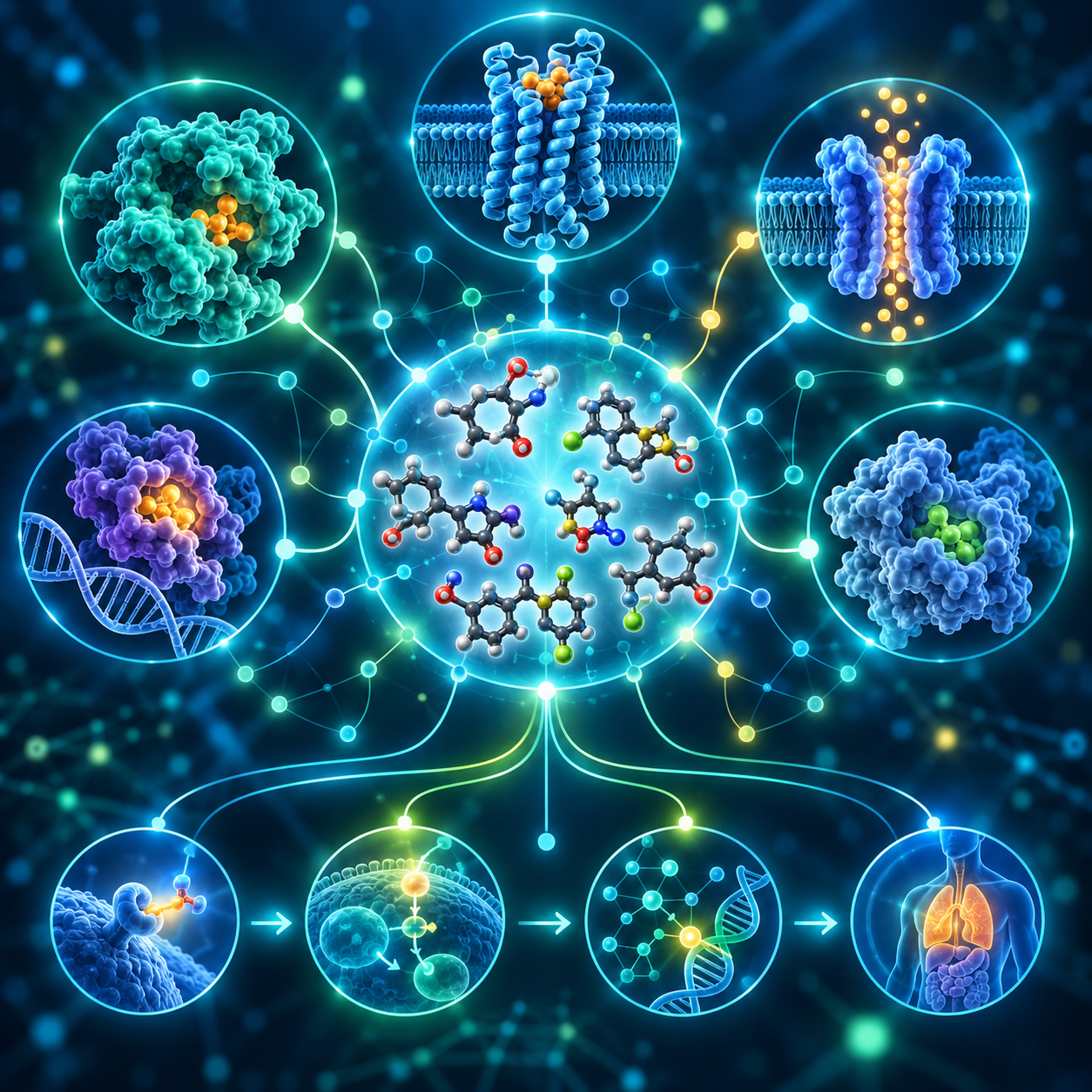
Annotated bioactive compounds are small molecules with experimentally confirmed biological activity against defined molecular targets. Each compound is linked to published bioactivity data: potency values, target identity, mechanism of action and, for drugs, clinical indications, allowing screening results to be interpreted directly in terms of target and pathway biology rather than chemical structure alone.
Such sets are widely used in target validation, phenotypic screening and target deconvolution, assay development and benchmarking, and drug repurposing studies, where a well-characterized, pharmacologically diverse reference collection accelerates the transition from a screening hit to a biological hypothesis.
The OTAVA Annotated Bioactives Library was developed using a data-driven cheminformatics workflow that systematically matched the entire OTAVA compound stock against the ChEMBL bioactivity database and retained only compounds supported by robust, curated activity data.
The following computational approaches were employed during the library design process.
1. Source of Bioactivity Data
Bioactivity information was obtained from ChEMBL, a manually curated open database of bioactive molecules with drug-like properties maintained by EMBL-EBI [1]. The latest full release, ChEMBL 37, comprising nearly 3 million distinct compound structures and bioactivity data for over 18,000 targets, was used.
Bioactivity annotations are derived from ChEMBL and are provided under the Creative Commons Attribution-ShareAlike 3.0 licence.
2. Structure Standardization and Matching
All compounds of the OTAVA stock, comprising approximately 300,000 small molecules, were processed with the ChEMBL Structure Pipeline [2] - the same standardization procedure that ChEMBL applies to its own records. Salts and solvates were reduced to their parent structures, ensuring that a salt and its free base are recognized as the same compound.
Standardized structures were matched to ChEMBL via InChIKey identifiers, including all salt forms registered in the database. As a result, approximately 35,000 OTAVA compounds were identified in ChEMBL.
3. Evidence-Based Selection
Presence in ChEMBL alone does not indicate biological activity, as many records originate from high-throughput screens reporting inactive results. Compounds were therefore retained only if they belonged to one of two evidence categories:
-
Approved drugs and clinical candidates - compounds with a recorded clinical development phase, annotated with mechanism of action and therapeutic indications where available
-
Potent research compounds - compounds with activity of 1 µM or better (pChEMBL ≥ 6) against a single protein target, measured in binding or functional assays with high target-assignment confidence and reported in curated sources such as the peer-reviewed literature
For each compound, the most potent target was assigned as its primary target, and up to three additional potent targets were recorded.
4. Quality Control
The selected compounds were subjected to several quality control steps:
-
Removal of pan-assay interference compounds (PAINS) using established substructure filters [3]
-
Exclusion of activity records flagged as potentially invalid or duplicated
-
Exclusion of compounds lacking an informative target, mechanism or indication annotation
-
Verification of stock availability and of structural identity against the OTAVA compound database
Compounds for which ChEMBL activity data refer to a specific stereoisomer are explicitly flagged in the library files.
5. Target and Therapeutic Annotation
Each compound is supplied with a structured annotation including its ChEMBL identifier and direct link, primary target, best potency value, mechanism of action and clinical indications.
Based on the ChEMBL protein classification and target identity, the compounds were assigned to more than 30 target-based research areas, including GPCR ligands, kinase inhibitors, ion channel and transporter modulators, nuclear receptor ligands, carbonic anhydrase, MAO, cholinesterase and PARP inhibitors, epigenetic modulators and E3 ligase ligands. Approved drugs and clinical candidates were additionally grouped into 12 therapeutic areas according to their indications.
The library covers over 700 biological targets and includes more than 100 compounds that are also part of the EUbOPEN chemogenomic compound set. Its physicochemical profile (median molecular weight ~270 Da, median LogP ~2.4, median TPSA ~59 Ų) is consistent with favorable properties for biological evaluation.
The resulting OTAVA Annotated Bioactives Library contains 1,760 compounds, including 717 approved drugs and clinical candidates and 1,043 potent research compounds, each supported by curated bioactivity data.
The library combines:
-
curated public bioactivity data
-
structure-verified, in-stock compounds
-
target and therapeutic-area annotation
making it a valuable resource for target validation, phenotypic screening and target deconvolution, assay development and drug repurposing research.
All the compounds are in stock, cherry-picking is available.
The libraries (DB, SD, XLS, PDF format) as well as the price-list are available on request. Feel free to contact us or use the online form below to send an inquiry if you are interested in obtaining this library or need more information.
Request Your Library Today! Fill out the form:
References
[1] Zdrazil, B. et al. The ChEMBL Database in 2023: a drug discovery platform spanning multiple bioactivity data types and time periods. Nucleic Acids Res. 52, D1180–D1192 (2024).
[2] Bento, A. P. et al. An open source chemical structure curation pipeline using RDKit. J. Cheminform. 12, 51 (2020).
[3] Baell, J. B. & Holloway, G. A. New substructure filters for removal of pan assay interference compounds (PAINS) from screening libraries and for their exclusion in bioassays. J. Med. Chem. 53, 2719–2740 (2010).
|

 HOME
 Overview